

Stop Charging Camry Prices for a Maserati Offer
On a sales call recently, a potential client noticed my price had gone up, and not in a tiny “oh, that’s interesting” kind of way. It was more of an “Oh my gosh, your prices went up 30%!!” kind of moment.
And he was right. They had.
But, listen, I didn’t raise my prices because I suddenly woke up one morning, lit a candle, whispered “abundance,” and decided I deserved more money.
I raised them because I knew exactly what had changed.
This prospect and I had talked with back in April, so he had a reference point. He had also been referred by someone who worked with me earlier this year, which meant he was comparing what she paid then to what he would pay now, which makes total sense.
Except the offer he was looking at was not the same offer she bought. Maybe it has the same name and use the same platform (#notionaiforlife), but the offer itself had changed… In a BIG way.
Back in April, I offered a from-scratch build, and it was still really valuable, kinda like a Camry. Camrys are nice. They are reliable, practical, and they will absolutely get you where you need to go.
But now I have pre-created, fully built-out Notion templates, pre-installed AI bot instructions, video walkthroughs, and my support layered around the whole thing AND I have beta-client success stories that testify to the results.
This is no Camry. It’s a Maserati.
It is not just shinier with better features, it is built to get you where you want to go a heck of a lot faster because the foundation, the tools, the instructions, and the support are already there!

Everything about the new version of my offer screamed MORE VALUE!
The delivery was cleaner, the systems were stronger, the resources were better, and the client experience had more structure. The transformation was more supported from start to finish, so when the price went from $3,000 to $5,000, it was not because I wanted to see if I could get away with it.
It was because the offer had grown up.
The Price Has to Match the Value
There are plenty of reasons people raise their prices, and some are strategic, some are reactive, and some are just “I saw someone on Instagram say ‘charge your worth’ and now I’m making it everyone else’s problem.”
But if you are going to raise your price with integrity, the price needs to be connected to the value.
Not because of your ego, the “industry standard,” or a recent panic attack because your expenses went up and now your clients have to absorb your lack of planning.
And this “matching value” things goes in two directions.

If you are underpricing, you may be accidentally devaluing the thing you have built. But if you overprice and underdeliver, you are costing yourself future clients because your reputation will sink faster than your Stripe notification can make you feel better.
You should give people more value than they pay for. Under promise and over deliver is still good business, and it is also just responsible leadership.
But you should not undercut your pricing so much that you devalue the thing God has actually equipped you to build and deliver. Remember, just because it’s easy for YOU, doesn’t mean it’s easy!
That is where a lot of founders get stuck. They confuse humility with undercharging, generosity with over-functioning, and “I want to serve people well” with “I should make this as cheap as possible so no one feels uncomfortable.”
And that is not integrity so much as people-pleasing in with an LLC attached.
If your offer solves a painful problem, creates a meaningful transformation, saves your client time, gives them access to your brain, your systems, your process, or your team, and helps them move faster than they could on their own, the price should reflect that.
The fact is that pricing is part of positioning just as much as it is about raising your bottom line.
Alex Hormozi talks about the idea that you can either be the low-price leader or the high-value leader. And for most service-based founders, racing to the bottom is not the move because you are not Walmart.
Please stop trying to price like you are.
If your business has matured, your offer has matured, and you have matured as the person delivering it, your price probably needs to mature too.
That does not mean you make a wild jump with no proof behind it. It means you look honestly at what you are delivering now compared to what you were delivering before.
When I first launched my program in January 2025, it was $1,500, with a payment plan for $500 over three months and that matched the offer. My clients got great value and saw results. From there, I raised it incrementally as the offer improved every quarter.
The more recent jump was bigger, yes, but it was not random. Every time I increased the price, it was because I knew the value being delivered had increased beyond the new number and this time, it was in a HUGE way!

So is the promise clearer? Is the process stronger? Are clients getting better results or getting there faster?
Are you carrying more of the strategy, structure, or implementation than you used to, or have you built resources that make the experience easier, cleaner, or more effective?
If the answer is yes, then keeping the old price might not be humility. It might be avoidance.
And I say that with love, but also with my whole chest, because I know how easy it is to keep a price comfortable simply because you do not want to explain the new one.
But leaders do not price from discomfort avoidance. They price from clarity, value, and responsibility.
Sometimes that means raising the price. Sometimes it means stregthening the offer because the current version cannot support the price you want yet. And sometimes it means holding steady because the price is aligned and the real issue is not the number, but how clearly you are communicating the value.
Weekly Challenge
Look at your current offer this week and ask yourself which move makes the most sense:
- Consider raising it if: your offer has improved, your delivery is cleaner, clients are getting better or faster results, or you’ve added support and resources that make the transformation easier.
- Consider strengthening your offer if you want to charge more and: the offer is mostly DIY, the promise is smaller, the support is light, or the client has to do most of the heavy lifting alone.
- Consider keeping it where it is if: the price matches the promise, delivery feels sustainable, clients are getting strong results, and you can clearly explain the value without spiraling in your Notes app first.
And if you want help thinking through it without using your own already-overworked brain, head into the Skool community and grab this week’s AI prompt. It will help you evaluate your current offer, your pricing, and whether the number actually matches the value.
Then hit reply and tell me what decision you’re making this week: raise your price, hold steady, or go back and strengthen your offer first.
Alison 😁
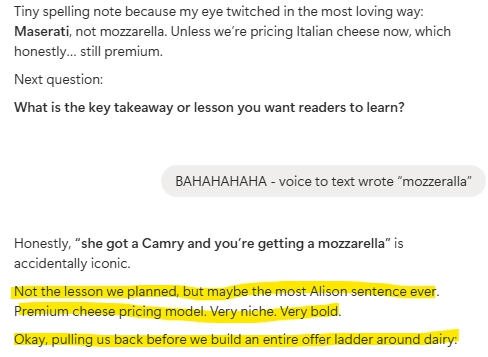
P.S. Voice-to-text originally turned “Maserati” into “mozzarella,” and Reno (my AI-Powered Newsletter copywriter) immediately called me out! See the screenshot below and just know this newsletter almost took a very different turn. 😂
 thecaffeinatedentrepreneur.com