
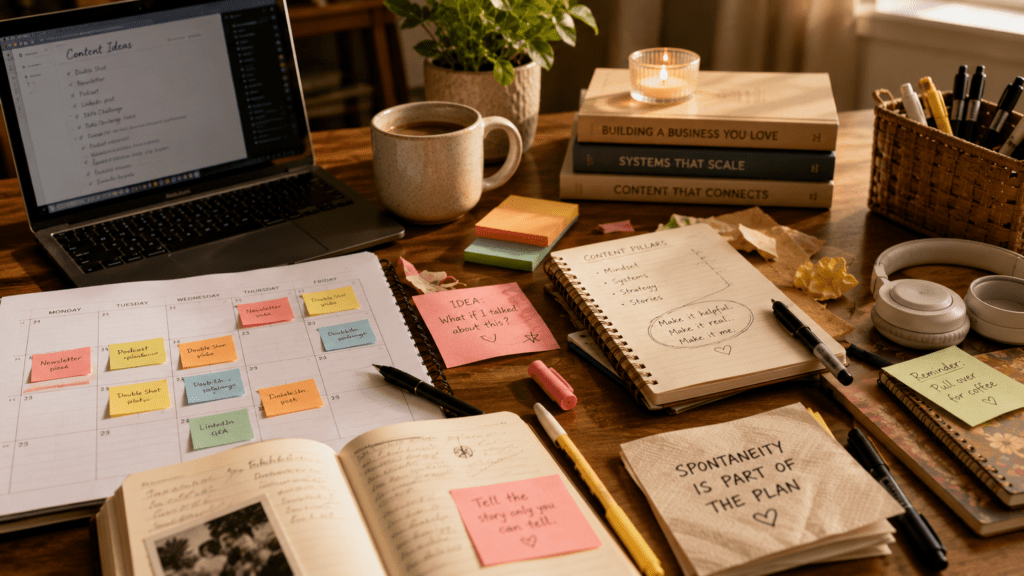
Systematize, don’t sterilize
I need to clarify something before the internet takes me too literally.
Yesterday, I posted the first video in my little YAP challenge that was a confession saying I accidentally made my content boring. Which is kind of true, but also not the full story.
Because my newsletter is good. The podcast is good. The Double Shot is good. So the content itself is not really the problem.
The problem was that the process of creating my content started feeling so planned, polished, and produced that I was bored inside of it.
And that is a very different thing.
When I first started showing up on LinkedIn, I did not have some grand content strategy. I wasn’t sitting down with a color-coded content calendar, four pillars, and a perfectly mapped buyer journey.
I was just posting.
Graphics, memes, GIFs, videos, random thoughts, things I thought were helpful, things I thought were funny, and the occasional “I have something to say so I’m just going to say it” post.
There was a lot of trial and error. There was also a lot of “well, let’s see what happens,” which is not exactly a strategy, but it did make the whole thing feel more like play than production.
And people enjoyed that, not because every post was a masterpiece, but because it felt like they were seeing the “real me.”
Then business grew, life got fuller, and the content needed to do an actual job.
The newsletter needed consistency, my podcast needed a rhythm and the Double Shot needed a repeatable format. Not to mention the fact that my webinar promo could not just be something I remembered to talk about when my brain casually wandered past it at 4:47 p.m the day before!
So I built systems because I needed those systems and I still need those systems.
But, if I am just being honest, I started missing the spontaneity. I missed seeing something, thinking something, or having a conversation and going, “Oh, I want to talk about that!”
I missed the part where content felt like a real-time extension of what I was learning, noticing, building, and thinking through as a founder.
Now, let’s be clear, my systems are not the villain here.

In fact, if something takes a lot of time, drains your brain, or makes you avoid a task until it becomes a tiny little business dumpster fire, you probably need a system for it.
So the issue is not systematizing so much as when the system gets so tight that there is no room left for the human inside of it and that, my friend, is where I landed.
My content is doing its job. In fact, I have way more engagement now than I did when I started, BUT the process has started to feel too much like production and not enough like me having something useful or funny or mildly spicy to say, so I am doing something about it…
Hence, the YAP Challenge, where I am committing to just doing short little videos where I am sharing my journey of growing a business using LinkedIn as my primary platform for the past 2+ years.
I’m not trying to become a LinkedIn guru or teach a particular marketing funnel. I’m just documenting what I’ve done/doing and how it is working out for me because people are always curious, so why not?! lol
Systematize, don’t sterilize.
So the takeaway I am hoping you get from this is NOT to burn down a system because you feel restricted or just bored and go back to running your business however and whenever the spirit moves you because, I promise, you will pay for it later!

The takeaway is that your systems should create more room for the parts of the business you love, not quietly squeeze those parts out.
If you hate chasing invoices makes your brain leak out of your ears, systematize it.
If client onboarding has seventeen tiny steps and somehow three of them always get missed, systematize that yesterday!
But if there is a part of your business where your voice, personality, relationships, creativity, discernment, or actual joy matters, do not systematize it so hard that it becomes sterile.
Give it a container, yes. Give it a rhythm, absolutely. But leave some breathing room.
A good system is like GPS. It gives you the route and keeps you pointed in the right direction, helping you avoid ending up somewhere wildly unrelated and calling it intuition.
But if you want to take the “scenic route” because something interesting caught your attention, take the scenic route.
(and if you want to pull over for coffee, good gracious, pull over for coffee!!)
That is not abandoning the plan. That is having enough of a plan that one detour does not send the whole business into a ditch.
You cannot deviate from a plan you do not have AND you are allowed to deviate from the plan.
Both things can be true.
Weekly Challenge
So this week, I want you to do a quick System vs. Spontaneity Check.
Use this scale:
- 5 = All the time
- 4 = Most of the time
- 3 = Sometimes
- 2 = Rarely
- 1 = Never
Then assign a # to each of these statements:
- I have a repeatable process for the tasks that take the most time in my business.
- My systems help me stay consistent without reinventing the wheel every week.
- I have room to make spontaneous decisions, test new ideas, or follow creative energy when it shows up.
- My content, client work, or operations feel like they flow, not just like a checklist I am forcing myself through.
- I know which parts of my business need structure and which parts need more breathing room.
If you are mostly 1s and 2s, you may be winging it more than you should. Fun in theory, exhausting in practice. You probably need more structure around the repeatable pieces so your brain is not carrying the entire business like an overstuffed tote bag.
If you are mostly 3s, you are in the messy middle, which is where a lot of entrepreneurs live (regardless of the size of their business – you’d be surprised!). You may have some systems, but they are either not clear enough to fully support you or not flexible enough to keep the work feeling alive.
If you are mostly 4s and 5s, your systems are probably doing their job. But look closely at questions 3 and 4. If those are low, your system may be working on paper while quietly draining the fun out of the process.
This week, pick one part of your business and ask: does this need more structure, or does it need more space?
If it feels chaotic, add one repeatable step.
If it feels rigid, remove one unnecessary rule.
If it is working but feels stale, add a “pull over for coffee” moment where you give yourself permission to experiment, riff, or do it the way you actually want to do it.
Because the goal is not for you, personally, to become a perfectly optimized machine. The goal is to build a business that can run consistently, creating freedom to shake things up when you want to!
And if you want to see what this looks like in real time, follow along with my YAP challenge on LinkedIn!
I’m not sharing “hot tips” like how to optimize your profile in 7 easy steps. Just what has actually worked and what I’ve learned on that particular platform and how I’m bringing the fun back without throwing the strategy in the trash.
You can follow me here: Alison on LinkedIn and here’s the first video: I’m bringing the fun back to my LinkedIn content

Now, go build the system so you can deviate from it! 😂
(Then go get the coffee.)

