

Your Reputation Sells You Better Than You Ever Will
A few months ago, I started talking with a prospect who was very interested in working with me.
And I mean very interested. He and his partner could see the value; they knew the business needed cleaner systems, and the conversations were good, but like most real business decisions, there were a lot of moving pieces, so nothing had officially moved forward yet.
It wasn’t a “no” or an awkward ghosting situation. Just the normal swirl of timing, priorities, budget conversations, and everything else that happens behind the curtain when two business owners are trying to decide what to do next.
Meanwhile, I have another client I’ve been working with on a consulting basis. She is a ClickUp person, not a Notion person.

(I know. We’re all shocked and mildly concerned, but the relationship itself has been so good.)
I’m helping her think through the systems and strategy, then she’s implementing it on her side. As a result, she’s felt a huge weight lifted off her shoulders as well as seen a direct impact on her revenue because of what we’ve built together.
Coincidentally, I had connected her with that prospect because his company offers a service she needed, so now they’re having their own conversations completely separate from me.
Apparently, my name came up on one of their recent calls.
I hadn’t asked her to bring me up and I wasn’t hovering in the background like, “Hey, if you happen to mention how brilliant and helpful I am, I wouldn’t be mad about it.”
(Not that I’m above that, just to be clear, lol)
She was giving my prospect feedback on her client experience with him and just started talking about the work we’ve been doing together. She told him she believed I could do amazing things inside their business because of the difference she had already experienced from our work truly believed they would make their investment back quickly.
When you’re not even in the room.
Friend, you can follow up with a prospect ten times and say all the same things about what you can do for them and their business, but it lands differently when it comes from someone who has actually been on the receiving end of your work.
THAT is your reputation.
Not the polished version you write on your website. Not the version you try to package into a pretty little sales paragraph. The real one that people repeat when you are not there to manage the conversation.
And your reputation will sell you better than you ever will or it will make people hesitate and even disappear, and you may never know why.

So it is a double-edged sword.
We love the idea of referrals when they’re warm and enthusiastic and make us feel like the business gods have smiled upon us, but reputation cuts both ways.
If someone had a bad experience with you, that travels too. While it’s highly unlikely they’ll blast you publicly or send a dramatic email, and even if they’re perfectly polite when your name comes up, they won’t send people your way.
And for high-ticket service providers, coaches, consultants, and experts, that matters a lot, because people are not just buying the deliverable. They are buying the experience of being led through something they likely cannot do on their own.
They are paying for your thinking, your process, your discernment, your communication, your ability to reduce the mess instead of adding to it.
If the experience feels confusing, chaotic, transactional, or like they have to drag the value out of you with both hands and a prayer, they are going to remember that.
And if the experience feels clear, thoughtful, steady, and valuable? They are going to remember that too and I also know this is true from the other side of the coin.
I have talked about my virtual events producer so much that my own coach joked that if she ever needed a producer, she would hire Bernie without thinking twice simply because she trusts my opinion of him! (ps – you should too 😉)
That is what a strong reputation does. It creates trust before the sales conversation even starts and if you want that reputation to work for you, there are three pieces I think you have to pay attention to.
What people are REALLY referring to when they say your name
The first is your character.
Why are you doing what you do? Do you actually care about the person in front of you, or are they just another payment plan, another testimonial, another little notch in your “look how successful I am” belt?
Even if they may not always be able to name it right away, they can feel when someone is stewarding the work with integrity and they can also feel it when someone is treating the relationship like a transaction.
That does not mean you have no boundaries. Please do not turn this into “Alison told me to over-give until I collapse into a pile of resentment and cold coffee.”
(I’ve tried that and I can promise you it does NOT end well.)
It means your character shows up in how you tell the truth, how you handle mistakes, how you communicate when things get messy, and whether you are genuinely invested in helping the client get the result they came for.
The second piece is the experience.
This is where a lot of business owners accidentally sabotage themselves because they are good at the actual work, but the experience around the work is clunky.
Maybe the onboarding is unclear or the communication is scattered and the client has to keep asking what happens next. The deliverables may be useful, but the path to get there feels like trying to assemble IKEA furniture with half the instructions missing.
And listen, most of us have had a season where the backend was held together with hope, caffeine, and one too many tabs open, so don’t beat yourself up here, but if you want people to refer you, the experience matters.
That’s just the facts.

The third piece is consistency.
One great experience is wonderful, but consistency is what makes someone confident enough to put their own reputation next to yours.
Because that is what a referral really is. When someone says, “You should work with Alison,” they are not just passing along a name; they are attaching their judgment to the recommendation. They are saying, “I trust this person enough to send you their way.”
And that is a HUGE deal, my friend.
People will only do that when they believe your excellence is not a fluke. They need to trust that you will show up with the same care, clarity, follow-through, and steadiness for the person they refer.
This is why I think we get a little too obsessed with scaling before we have earned the right to scale. Better to deliver scarce value even if it is not scalable… yet.
That means have the extra conversation, notice the friction and pay attention to what clients keep asking. Build the manual version long enough to understand what pieces of the system actually need to be automated or delegated.
You do not need a fully automated, perfectly scalable, angels-singing-from-the-clouds client experience before you have proof that the experience is worth referring.
You need to be good, useful and trustworthy. You need to create the kind of experience that makes someone think, “Oh, I know exactly who needs this.”
Then, as you grow, you can make it cleaner, building the system to tighten the process and create the version that supports more clients without watering down the value.
But do not skip the part where your reputation is being formed in the small, unsexy moments. The way you make someone feel when they are confused, overwhelmed, or unsure what to do is the stuff people remember.
And as long as you do not quit, you will keep getting better and you will keep seeing where the experience needs to improve. You will keep learning what people value most and keep building the kind of reputation that enters rooms before you do.
And that part is being built right now.
Weekly Challenge
This week, I want you to take an honest look at the reputation that is already preceding you.
And before you say, “Well, I don’t really have a reputation because not enough people know about me,” I’m going to lovingly stop you right there.
You do have one.
If you have worked with clients, talked to prospects, shown up online, delivered a service, missed a deadline, saved someone’s sanity, made something easier, or left someone wondering what on earth just happened, you have a reputation.
So start by looking at what people have already said about that experience.
Read your testimonials. Go back through old messages, voice notes, DMs, and follow-up emails. Look for the patterns. What do people thank you for? What do they say felt different? What words keep showing up?
Then ask a few current or past clients (actual or idea) this: “Would you refer me to someone else? If yes, why? If not, what would need to improve before you felt comfortable doing that?”
That question might make you want to crawl under your desk for a minute. Understandable. Bring coffee and chocolate to the conversation, but ask it anyway.
You are not asking so people can pump your ego or give you a gold star. You are asking because honest feedback is data.
If people would refer you, you need to know what they are actually referring to. If they would not, you need to know what part of the experience is creating hesitation.
That is how you improve.
And if you want help turning that reflection into something actually useful, head to my Skool community and grab the prompt you can drop into your favorite LLM to walk you through it.
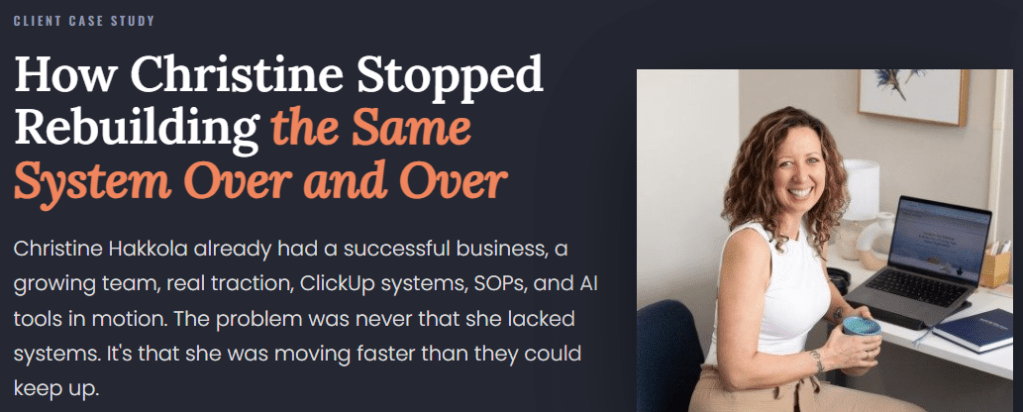
You can also check out the client case study I mentioned here: https://leadsmarterco.com/consulting-client
Your reputation is already talking; let’s make sure it is saying what you want it to say.

